SEO vs AEO: What's the Difference and Which Matters More in 2026?
Search is changing. People no longer rely exclusively on Google to find information, compare products, or discover businesses.
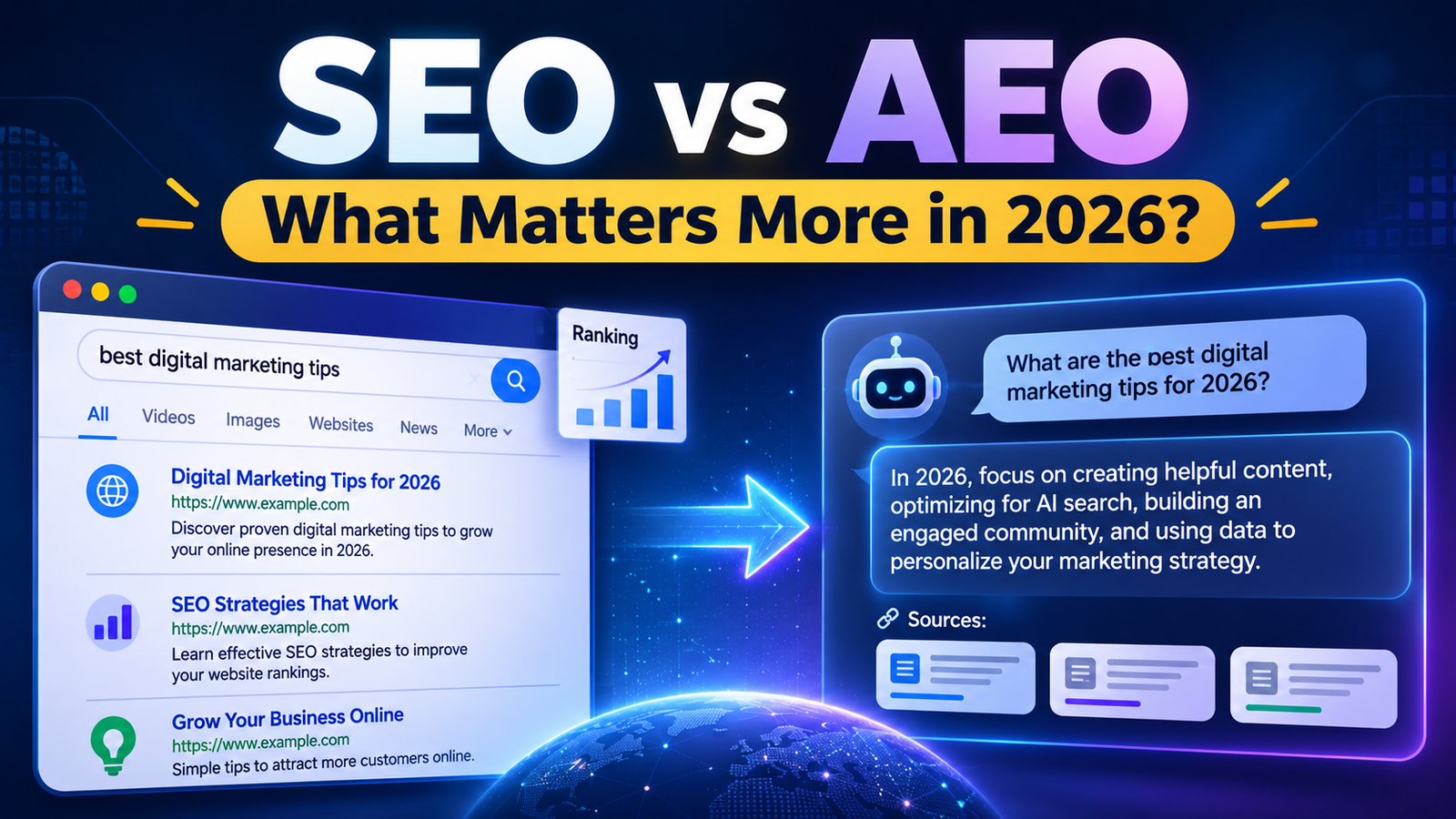
Search is changing. People no longer rely exclusively on Google to find information, compare products, or discover businesses. Increasingly, they turn to AI-powered platforms such as ChatGPT, Perplexity, and Google's AI Overviews to get direct answers to their questions.
This shift has introduced an important question for website owners, bloggers, and digital marketers: Is traditional SEO still enough, or should businesses start focusing on Answer Engine Optimization (AEO)?
Understanding SEO vs AEO is becoming essential for anyone who wants to maintain online visibility in 2026.
Although both strategies aim to make content easier to discover, they focus on different outcomes. SEO helps websites appear in search results, while AEO focuses on making information useful and accessible within direct answers generated by search engines and AI assistants.
Let's explore how they work, where they differ, and why combining both approaches is the smartest strategy for sustainable online growth.
What Is SEO (Search Engine Optimization)?
Search Engine Optimization, commonly known as SEO, is the process of improving a website so that its pages can appear more prominently in organic search engine results.
When someone searches for a phrase on Google or Bing, search engines evaluate numerous factors to determine which pages are most relevant and useful.
SEO helps search engines discover, understand, and evaluate your content.
For example, imagine someone searches for:
"What are the best ways to improve website speed?"
A website that publishes a detailed, helpful guide covering website performance, image optimization, caching, and technical improvements may appear in the search results if it satisfies the query and performs well against competing pages.
How Does SEO Work?
SEO generally involves three important areas:
1. Technical SEO
Technical SEO ensures that search engines can access, crawl, and understand your website.
It includes:
- Improving website loading performance.
- Making the website mobile-friendly.
- Creating XML sitemaps.
- Fixing broken links and crawl errors.
- Using HTTPS.
- Implementing appropriate canonical tags.
- Improving website architecture.
2. On-Page SEO
On-page SEO focuses on optimizing individual website pages.
Common activities include:
- Using relevant keywords naturally.
- Writing descriptive title tags and meta descriptions.
- Organizing content with H1, H2, and H3 headings.
- Adding descriptive image alt text.
- Creating useful internal links.
- Matching content with search intent.
3. Off-Page SEO
Off-page SEO involves activities that build a website's reputation and authority beyond its own pages.
Examples include:
- Earning backlinks from relevant websites.
- Digital public relations.
- Getting mentioned by trusted publications.
- Building genuine brand recognition.
- Developing industry relationships.
The ultimate goal of SEO is to attract relevant organic visitors, build website visibility, and support business growth.
What Is AEO (Answer Engine Optimization)?
Answer Engine Optimization (AEO) is the practice of improving content so that search engines, AI assistants, and other answer-focused platforms can understand, retrieve, and potentially use it when responding to users.
Unlike a traditional search experience, where users receive a list of website links, answer engines often provide a summarized response directly.
For example, someone might ask ChatGPT:
"Which website platform is better for a small business: WordPress or Shopify?"
Instead of browsing several websites individually, the user may receive a comparison explaining the differences, advantages, limitations, and suitable use cases.
The AI system may also provide links or citations to supporting sources.
AEO aims to improve the chances that your content or brand becomes one of the sources these systems reference.
How Does AEO Work?
AEO focuses on making information clear, relevant, trustworthy, and easy to interpret.
Some important practices include:
1. Answer Questions Directly
Start important sections with clear answers rather than lengthy introductions.
For example:
Instead of writing several paragraphs before explaining website hosting, begin with a simple definition and then provide additional details.
This makes your content easier for readers and information retrieval systems to understand.
2. Use Clear Content Structure
Organize your content using:
- Descriptive headings.
- Short, focused paragraphs.
- Relevant bullet points.
- Comparison tables.
- Question-and-answer sections.
- Clearly explained examples.
3. Demonstrate Expertise and Trustworthiness
AI systems need reliable information to generate useful answers.
Publish original insights, support important claims with credible sources, identify authors, and keep factual information updated.
4. Build Consistent Brand Information
Make sure your business name, services, descriptions, expertise, and other important information are consistent across your website and relevant online platforms.
5. Cover Related Questions
Think beyond the exact keyword.
If someone searches for website hosting, related questions might include:
- What is website hosting?
- How much does hosting cost?
- Which hosting type is suitable for beginners?
- What is the difference between shared and VPS hosting?
Addressing relevant questions creates a more useful resource.
SEO vs AEO: Key Differences Explained
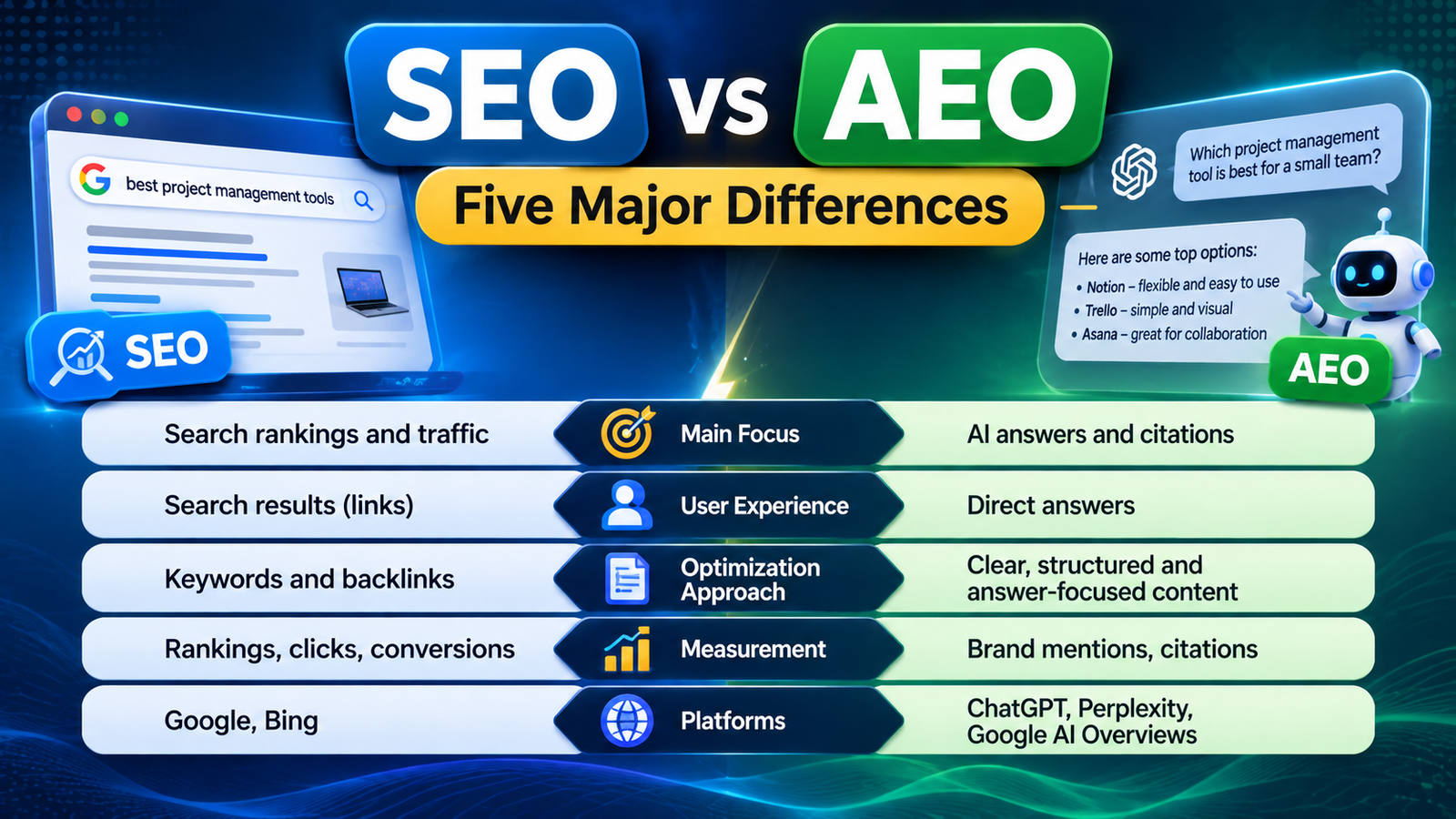
Although SEO and AEO share several principles, their main objectives are different.
SEO primarily focuses on improving organic search visibility, while AEO focuses on improving the likelihood of being included in direct answers and AI-generated responses.
Here is a practical comparison:
| Comparison | SEO | AEO |
|---|---|---|
| Full form | Search Engine Optimization | Answer Engine Optimization |
| Main objective | Improve organic search visibility | Improve visibility in direct answers |
| Primary focus | Search rankings and relevant traffic | AI answers, citations and brand mentions |
| User experience | Users explore search results | Users receive summarized answers |
| Content approach | Comprehensive, relevant content | Clear, structured and answer-focused content |
| Important practices | Keywords, backlinks, technical SEO | Clear answers, contextual information, trustworthy sources |
| Platforms | Google, Bing and other search engines | ChatGPT, Perplexity, Google AI features and other answer engines |
| Measurement | Rankings, impressions, clicks and conversions | AI mentions, citations and answer visibility |
| Main opportunity | Attract visitors to your website | Make your brand discoverable through generated answers |
The important distinction: SEO and AEO are not completely separate marketing disciplines. They overlap considerably, and many practices that improve traditional search visibility can also support AI search visibility.
SEO vs AEO: Five Major Differences
Understanding their individual characteristics makes it easier to decide where to invest your time and resources.
1. Different Search Experiences
Traditional SEO is built around helping users discover relevant website pages through search results.
AEO focuses more on answer-oriented experiences where users expect a direct response.
For example:
- SEO search: "Best project management software for small businesses."
- AEO-style question: "Which project management software is best for a small team with a limited budget?"
The second question provides more context and may require an answer that compares several options.
Both queries can be valuable opportunities for content creators.
2. Different Content Presentation
SEO requires relevant, comprehensive content that satisfies the searcher's needs.
AEO places additional emphasis on making individual answers easy to identify and understand.
For example, a traditional SEO article about email marketing might include:
- Introduction to email marketing.
- Benefits of email marketing.
- Different email marketing platforms.
- Marketing strategies.
- Examples and recommendations.
An AEO-friendly version can retain all these sections while adding direct answers to relevant questions.
This approach serves both readers who want a quick explanation and those who want detailed information.
3. Different Visibility Opportunities
SEO helps your website compete for visibility in traditional organic search results.
AEO creates opportunities for your information or brand to appear in:
- AI-generated summaries.
- Conversational search responses.
- Answer-focused search experiences.
- AI-powered recommendations.
- Responses containing external citations.
However, being mentioned by an AI system does not automatically mean users will visit your website. This makes brand visibility and website traffic two separate outcomes worth measuring.
4. Different Performance Measurements
SEO performance can be evaluated through established metrics such as:
- Organic clicks.
- Search impressions.
- Keyword rankings.
- Click-through rate (CTR).
- Organic conversions.
- Organic revenue.
AEO requires additional visibility measurements, including:
- How frequently your brand appears in AI responses.
- How often your website is cited.
- Which questions trigger brand mentions.
- Which competitors appear in the same responses.
- Whether AI-generated recommendations accurately describe your business.
These measurements are not yet standardized across all answer engines, so comparisons should use consistent questions, platforms, and tracking periods.
5. Different Optimization Priorities
SEO focuses on helping search engines discover, evaluate, and rank website content.
AEO adds another consideration: making specific information easy to retrieve and use in generated answers.
For instance, an article can rank well for a keyword but still fail to appear in an AI-generated response.
Similarly, a website might receive an AI citation without ranking prominently for the exact keyword a marketer tracks.
This is why monitoring both types of visibility is increasingly useful.
Does AEO Replace SEO in 2026?
No. AEO does not replace SEO.
In fact, traditional SEO remains an important foundation for improving visibility across modern search experiences.
Google's official guidance explains that the same foundational SEO practices remain relevant for AI Overviews and AI Mode. Pages must meet Google's existing technical requirements and be eligible to appear in Search with a snippet. There are no additional special technical requirements specifically for these AI features.
This is an important point because many businesses assume they need an entirely new optimization system to appear in AI-generated answers.
They don't.
Strong technical foundations, useful content, clear website architecture, and trustworthy information remain important.
However, relying exclusively on traditional keyword rankings may leave businesses less prepared for the growing variety of AI-powered discovery experiences.
A better approach is to strengthen your SEO strategy while incorporating relevant AEO practices.
How to Build an Effective SEO and AEO Strategy in 2026
You don't need two completely separate content strategies. You can create one strong content system that supports both traditional search and answer engines.
Here are six practical steps.
Step 1: Understand Your Audience's Questions
Start by identifying what your audience actually wants to know.
Look beyond individual keywords and consider the questions people ask before making a decision.
For example, if you run a website design business, your audience might search for:
- How much does website development cost?
- Is WordPress suitable for small businesses?
- How long does it take to build a website?
- What should a business website include?
Create content around genuine customer questions rather than publishing articles simply to target more keywords.
Step 2: Create Helpful, Original Content
Content quality should remain your primary focus.
Avoid publishing articles that simply repeat information available on dozens of other websites.
Instead:
- Include original explanations.
- Add practical examples.
- Use reliable references.
- Explain limitations and exceptions.
- Include relevant industry insights.
- Update outdated information.
Original research, meaningful comparisons, and useful demonstrations can give readers a reason to choose your content over competing resources.
Step 3: Structure Content for Easy Understanding
Use a logical content hierarchy.
A useful structure might look like this:
- H1: Main article topic.
- H2: Main question or subject.
- H3: Supporting explanation.
- Short paragraphs: Clear information.
- Tables: Comparisons where useful.
- FAQs: Additional relevant questions.<
Whenever a section addresses a specific question, provide a direct answer near the beginning before expanding on the details.
Remember that concise answers are helpful, but there is no universal word count or paragraph length that guarantees an AI citation.
Step 4: Strengthen Your Website's Technical SEO
Even excellent content needs a technically accessible website.
Review the following:
- Make sure important pages can be crawled.
- Check whether important pages are indexed.
- Improve mobile usability.
- Fix broken internal links.
- Maintain a clear website structure.
- Use appropriate structured data where applicable.
- Ensure important information is available as readable text.
- Keep your sitemap accurate.
Do not assume that adding special AI files or unnecessary schema markup will automatically improve AI visibility.
Google explicitly states that no special AI-specific schema or machine-readable file is required for inclusion in its AI search features.
Step 5: Build Brand Authority Beyond Your Website
Your website should not be the only place where people can discover your business.
Develop a consistent online presence through:
- Relevant industry publications.
- Professional communities.
- Genuine customer reviews.
- Industry partnerships.
- Useful guest contributions.
- Relevant business directories.
Focus on earning genuine recognition rather than creating artificial brand mentions or low-quality backlinks.
Step 6: Track SEO and AI Search Performance Separately
Use traditional analytics and available AI visibility tools to understand how people discover your content.
For SEO, monitor Google Search Console and your website analytics platform.
For AI visibility, maintain a list of relevant questions and test them consistently across selected answer engines.
Record:
- Whether your brand appears.
- Whether your website is cited.
- Which competitors are mentioned.
- Whether the answer describes your business accurately.
- How visibility changes over time.
Microsoft's Bing Webmaster Tools also provides an AI Performance feature that can help website owners review their content's presence in AI-generated answers.
Practical Example: How One Blog Can Target Both SEO and AEO
Imagine you operate a website that publishes digital marketing guides.
You decide to write an article about:
"How to Start a Blog in 2026."
Here is how you can approach it.
For SEO:
- Research the primary keyword.
- Identify related search terms.
- Create an informative title and meta description.
- Write a comprehensive guide.
- Optimize images and internal links.
- Improve technical accessibility.
For AEO:
- Begin the article with a direct explanation of how to start a blog.
- Include clear answers to common beginner questions.
- Explain the differences between free and paid blogging platforms.
- Add a practical setup checklist.
- Support recommendations with reliable references.
- Keep platform-related information accurate and updated.
The result is one comprehensive article designed to serve readers with different search behaviours.
Someone looking for a complete tutorial can explore the entire guide, while someone looking for a quick answer can find relevant information quickly.
This is the real advantage of combining SEO and AEO: you don't have to sacrifice content depth to make information easier to understand.
Common AEO Mistakes Businesses Should Avoid
As businesses explore AI search optimization, some practices can waste resources or reduce content quality.
1. Ignoring Traditional SEO
Focusing exclusively on AI visibility while neglecting technical SEO, indexing, and content quality can limit your website's discoverability.
2. Writing Content Only for AI
Your primary audience is still people.
Avoid creating unnatural paragraphs, repetitive questions, or awkward keyword combinations simply to make content appear AI-friendly.
3. Adding Unnecessary Structured Data
Structured data helps search engines interpret specific information, but it does not guarantee rankings, AI citations, or special search appearances.
Only use markup that accurately describes visible page content and follows the relevant platform's guidelines.
4. Publishing Too Much Low-Quality Content
Publishing dozens of automatically generated articles without meaningful research, original information, or editorial review can harm content quality.
Focus on usefulness and accuracy instead of publishing frequency.
5. Ignoring Brand Reputation
AI visibility is not only about optimizing individual website pages.
Your business information, expertise, reputation, and external references also matter when people and platforms evaluate your brand.
6. Expecting Immediate Results
Neither SEO nor AEO guarantees immediate visibility.
Search engines and AI systems can change their results, sources, and responses over time. Consistent improvement and measurement are more useful than expecting instant results.
Which Strategy Should You Prioritize: SEO or AEO?
The answer depends on your website, business model, audience, and current marketing performance.
| Your Situation | Recommended Priority |
|---|---|
| New website or blog | Build strong SEO foundations first |
| Established website receiving organic traffic | Maintain SEO and expand AEO |
| Small business targeting local customers | Local SEO and accurate business information, alongside AEO |
| Content creator or blogger | Content-focused SEO with answer-friendly structure |
| SaaS or technology business | SEO, product-led content and AI visibility |
| Established brand | Combine SEO, AEO, digital PR and brand reputation |
For beginners, starting with traditional SEO is generally the more practical decision because it establishes the technical and content foundations needed for broader search visibility.
As your website grows, you can introduce more deliberate AEO measurement and optimization.
Businesses that already have a strong SEO foundation should consider AI search visibility as an additional growth opportunity rather than abandoning existing strategies.
Conclusion: SEO and AEO Work Better Together
The discussion around SEO vs AEO isn't really about choosing one strategy and abandoning the other. It's about understanding how people discover information and adapting your content accordingly.
Traditional SEO continues to provide the foundation for website visibility, while Answer Engine Optimization creates additional opportunities to reach audiences through AI-powered search experiences.
For bloggers, content creators, freelancers, and businesses, the smartest approach in 2026 is to invest in useful content, maintain strong technical SEO, build genuine brand authority, and make important information easy to understand.
Search technology will continue to evolve, but one principle remains valuable: create content that genuinely helps people.
At BrowseBrief, we believe better knowledge leads to better decisions. Explore more. Know Better.
Frequently Asked Questions
Find answers to common questions about this topic.
Comments (0)
Have a question or something to add? We'd love to hear from you.
Be the first to share your thoughts.